A low price per litre does not tell you whether an admixture will hold slump, meet setting limits, or work with your cement and aggregate. By the end, you will have a supplier-screening process based on standards, controlled trials, documentation, delivered cost, and production support.
Key takeaways
- Match the admixture to the concrete problem before comparing suppliers.
- Run a controlled trial mix using your project materials and target performance.
- Require batch numbers, technical data sheets, and certificates for every delivery.
- Compare delivered cost per cubic metre, not drum or bag price alone.
Match the admixture category to the concrete problem
A water reducer targets lower water demand at similar workability; a high-range water reducer targets major water reduction or high flow. A set retarder extends setting time, while an accelerator shortens it. A viscosity-modifying admixture controls segregation and bleeding in highly flowable concrete. Curing and integral waterproofing products address moisture movement, not slump.
Do not compare these categories as interchangeable.
| Function | Concrete problem | ASTM C494/C494M classification |
|---|---|---|
| Water reduction | Lower water at similar slump | Type A |
| Retarding | Longer setting time | Type B |
| Accelerating | Shorter setting time | Type C |
| Water reduction plus retarding | Lower water and delayed set | Type D |
| Water reduction plus accelerating | Lower water and faster set | Type E |
| High-range water reduction | Major water reduction or high flow | Type F |
| High-range water reduction plus retarding | High flow with delayed set | Type G |
| Specific performance | Defined project-specific function | Type S |
Before comparing a concrete admixture supplier, require the applicable class and measurable acceptance limits. For Indian projects, request evidence against IS 9103; use IS 1199 for fresh-concrete tests and IS 516 for strength tests. If the specification names ASTM compliance, demand ASTM C494/C494M results, not merely “superplasticizer.”
- Set limits for water reduction, slump, slump retention, setting time, air content, bleeding, segregation, 7-day strength, 28-day strength, and specified durability tests.
- For reinforced, prestressed, or post-tensioned concrete, require reported chloride-ion content or classification. “Chloride-free” is not an acceptance value.
Qualify compatibility through a controlled trial mix
A supplier’s admixture earns approval only when it performs in your proposed concrete, not merely in a laboratory report. Run a controlled trial mix using the actual cement, slag, fly ash, silica fume or calcined clay, aggregate sources, sand grading, aggregate moisture, mixing water, and every other admixture.
1. Ask the supplier to test the complete binder and aggregate system. Give PCE admixture extra scrutiny when manufactured sand or clay-bearing aggregate is present; request evidence from that project source, not washed laboratory sand. Test the dosage range in the technical data sheet rather than copying a percentage from another mix.
2. Record the water-cement ratio, batch size, addition sequence, concrete and ambient temperature, target slump, slump at discharge, slump retention after the required transport time, air content, setting time, bleeding, segregation, finishability, and 7-day and 28-day strength.
Use ASTM C231 or ASTM C173 for air content when applicable, ASTM C191 or the specified method for setting time, and ASTM C39 or IS 516 for compressive strength.
3. Confirm whether concentrated liquids require dilution or separate addition. Never premix two concentrates until the supplier confirms the sequence in writing. Repeat the trial at expected hot or cold placement temperatures; temperature can change slump loss, setting and strength development.
4. If waterproofing matters, assess reduced absorption or permeability separately from crack, joint, waterstop and penetration protection. ASTM C1202 results alone do not prove resistance to leakage through cracks or joints.
Demand documents that make every batch verifiable
A certificate of analysis is useful only when it identifies the supplied lot and lists defined acceptance tests. A density or appearance check cannot reveal every change in setting behaviour or air entrainment.
Request these records before approval:
- Current technical data sheet: dosage range, density, chloride content, recommended use, compatibility limits, addition sequence, temperature guidance, and test methods.
- Safety data sheet, certificate of analysis, batch or lot number, manufacturing date, stated shelf life, storage instructions, conformity or test reports, and retained-sample policy.
- Batch traceability linking the delivery note to production records and retained samples.
| Document | What to verify | What failure it helps expose |
|---|---|---|
| Technical data sheet | Approved dosage, limits, sequence, temperature range | Wrong use or incompatible batching |
| Certificate of analysis | Supplied lot, defined acceptance tests, release status | Unverified or off-specification material |
| Storage record | Temperature limits, agitation, contamination controls, evaporation protection | Concentration or performance change |
| Complaint procedure | Contact, evidence, investigation stages, replacement or quarantine rule, target timeline | Unresolved site failures |
Storage instructions must address freezing, overheating, agitation, contamination, evaporation, and freeze-thaw recovery. Ask how an aged batch is released or rejected; a sealed container is not proof of usable material.
For a substitution, compare performance against the approved mix’s acceptance criteria, not an equal dosage. Request results for water reduction, slump retention, set time, air content, strength development, finishability, and specified durability tests. Reject any change that lacks documented lot traceability or a controlled off-specification decision.
Compare supplier capability and delivered cost per cubic metre
Compare suppliers on delivered cost per cubic metre, not the drum price. Use the trial-approved dosage, product concentration, transport, unloading, storage equipment and expected wastage to calculate the quantity and cost for each cubic metre.
| Cost or capability | Low price per litre or kilogram | Higher unit price |
|---|---|---|
| Delivered admixture cost | Can rise with higher dosage, dilution or wastage | Can fall if the approved dosage is lower |
| Unplanned cost | Add rejected or quarantined batches, retesting, extra cement or water, truck delays, unusable concrete and site labour | Include the same risks, then compare documented controls |
| Supply continuity | Check volume, lead time and lot availability | Check whether production can maintain the approved lot sequence |
Ask whether each bidder can supply the required volume on the pour schedule. Confirm delivery reliability, minimum order quantity, emergency delivery arrangements and who attends a failed trial or site complaint.
Test supplier technical support before award. Require a plant trial, dispensing-pump calibration, reconciliation of target dosage against actual batch records, tank-agitation guidance and help when viscosity or concentration changes. A fixed pump volume can underdose a concentrated batch and cause slump loss.
Request storage equipment requirements, shelf-life controls and instructions for freezing, overheating, evaporation and contamination. If Wizplast Chemicals Pvt. Ltd. is shortlisted, require the same trial records, batch documents, storage guidance and production-support commitments demanded from every bidder.
The winning supplier is the one that reproduces approved performance through production, delivery and complaint resolution—not the one with the lowest invoice rate.
Related products
 | PCE Based Admixture WIZPLAST - 833 SC is a high-performance PCE (Polycarboxylate Ether) based admixture, specially formulated to enhance the workability, durability, and... View product → |
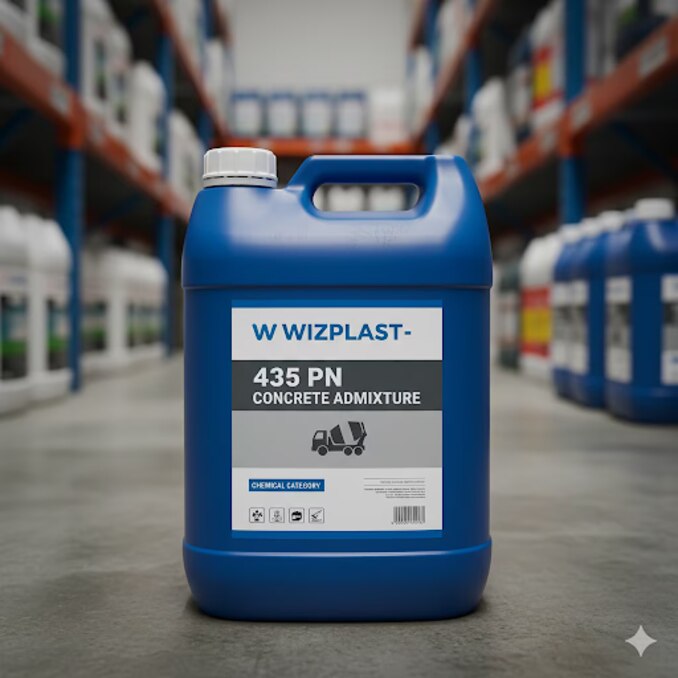
 | CONCRETE ADMIXTURE WIZPLAST-435 PN, offered by Wizplast Chemicals Pvt. Ltd., is a high-performance concrete admixture designed to enhance the workability, strength, and... View product → |
Turn the evidence into an approval and monitoring decision
1. Build a supplier selection checklist with two scored sections: product performance and supplier capability. Set a minimum score for each section; a strong product cannot compensate for poor traceability or unreliable delivery.
2. Score product performance against the applicable IS 9103 or ASTM C494/C494M classification, trial results, approved dosage range, slump retention, setting time, air content, bleeding, segregation, strength, chloride content, and project-specific durability requirements. Reject comparisons based only on price, dosage, or a generic “superplasticizer” claim.
3. Score supplier capability for document completeness, lot traceability, shelf-life control, delivery reliability, pump calibration, technical response, complaint closure, and off-specification handling. Require current conformity reports, technical and safety data sheets, certificates of analysis, batch records, storage guidance, and a defined quarantine or replacement process.
4. Increase the evidence threshold for hot-weather placement, long haul times, post-tensioned concrete, self-compacting concrete, and waterproofed basements. For freeze-thaw exposure, require the specified field air test and hardened-air-void testing under ASTM C457 when the specification calls for it; truck air percentage alone is insufficient.
Record crack-control, construction-joint, waterstop, and penetration details separately from admixture performance.
5. Approve the supplier only after its plant reproduces the trial mix. Put the accepted product, dosage range, addition sequence, test methods, batch records, formulation-change notification rules, and rejection procedure in the contract.
Monitor every delivery against the approved records, and requalify after any change in cement, SCM, aggregate, water source, temperature range, or admixture combination.
Frequently asked questions
How do you match an admixture to a concrete problem?
Use a water reducer for lower water demand, a high-range water reducer for major water reduction or high flow, a retarder to extend setting time, an accelerator to shorten setting time, and a viscosity-modifying admixture to control segregation and bleeding. Use curing or integral waterproofing products for moisture movement rather than slump control.
What should a controlled admixture trial mix include?
Use the same cement, supplementary cementitious materials, aggregates, water, dosage range, mixing sequence, temperature, and target slump as the project. Record slump retention, setting time, air content, bleeding, segregation, compressive strength, and compatibility with other admixtures.
Which documents make an admixture batch verifiable?
Ask for the technical data sheet, safety data sheet, certificate of analysis or conformity, batch number, manufacturing date, shelf life, storage instructions, dosage range, and test results linked to the supplied batch. Check that the delivery label matches the documents.
How should you compare concrete admixture suppliers?
Compare product performance, trial-mix evidence, technical support, lead time, minimum order, storage requirements, replacement policy, and delivered cost per cubic metre. Include dosage, transport, wastage, rejected loads, and any changes to cement or water content.
Related products
 | CONCRETE ADMIXTURE WIZPLAST - 1315 UT is a premium-grade concrete admixture developed by Wizplast Chemicals Pvt. View product → |
 | CONCRETE ADMIXTURE WIZPLAST - 555 RM is a high-performance concrete admixture designed to enhance the quality, durability, and workability of concrete. View product → |
 | CONCRETE ADMIXTURE WIZPLAST - 8427 WZ is a high-performance concrete admixture developed by Wizplast Chemicals Pvt. View product → |
 | CONCRETE ADMIXTURE WIZPLAST-5736 SP is a high-performance superplasticizer admixture specially formulated by Wizplast Chemicals Pvt. Ltd. View product → |