Concrete that looks fluid at discharge can still fail through slump loss, segregation, unstable air content, or delayed setting. You will be able to define an acceptable flow target, run a controlled admixture trial, compare SNF and PCE products, and qualify a supplier using evidence rather than a low price per litre.
Key takeaways
- Set slump or slump-flow targets before comparing admixtures.
- Run plant or field trials using the actual cement, aggregate, and mixing sequence.
- Add superplasticizer at the tested dosage and record water, timing, and concrete temperature.
- Choose SNF or PCE based on retention, compatibility, placement demands, and trial results.
How Do You Define Acceptable Concrete Flow?
Acceptable concrete flow is a measured placing performance, not the highest possible slump. Set the requirement before comparing admixtures: use ordinary slump for conventional concrete, and use slump flow when the mix must spread as flowing concrete, especially for highly workable or self-consolidating concrete.
1. Run the slump test under ASTM C143/C143M for conventional concrete. Record the measured vertical drop in millimetres, along with the concrete temperature. For flowing concrete, specify a target slump flow spread in millimetres and visual stability; a high spread does not prove that the mix is uniform or suitable.
2. Check more than initial flow. Measure retention at the expected haul and placing time, then check bleeding, segregation, setting behaviour, air content, and compressive strength at the specified ages. A mix that arrives fluid but loses flow before placement, traps unstable air, or bleeds excessively has not met acceptable concrete flow.
3. Ask how the supplier qualified the product. For flowing-concrete admixtures, identify ASTM C1017/C1017M Type I, plasticizing, or Type II, plasticizing and retarding. For broader high-range water reduction, identify ASTM C494 Type F or ASTM C494 Type G and state whether retarding behaviour is required.
These classifications are not interchangeable. “Superplasticizer” alone does not define performance, and achieving flow by adding water can increase the water-to-cementitious-material ratio, reducing strength or durability. Accept the admixture only against the complete flow, stability, timing, and strength criteria.
How Should You Run a Field or Plant Admixture Trial?
Approve a concrete admixture trial only after fixing one controlled mix and recording every variable that could change flow or strength.
1. Record the concrete grade, cement source and type, cementitious-material proportions, fly ash or slag content, aggregate sizes, aggregate moisture, sand condition, batch water, initial slump or slump flow, target flow, and concrete temperature.
2. Record the admixture product and batch number, dosage, addition point, mixing sequence, and mixer time. Do not compare suppliers if one trial uses a different water correction, batching order, or mixing duration.
3. Measure the initial result, then repeat the test at 30, 60, and 90 minutes, or at the actual haul and placing intervals. This establishes slump retention instead of approving a product on initial flow alone.
4. At every interval, check slump or slump flow, air content, bleeding, segregation, and concrete temperature. Use air content ASTM C231 for pressure-method testing in normal-weight concrete; use ASTM C173 when lightweight or highly porous aggregate makes the pressure method unsuitable.
5. Add setting-time and compressive-strength checks when the product data sheet, specification, or project risk requires them. A higher flow that increases water demand or weakens later-age strength is not a successful trial.
6. Keep one cement source and one aggregate combination during supplier comparison. After selecting the qualified dosage and procedure, repeat it in a plant trial before production approval, including the actual batching, transport, and placing sequence.
How Do You Set Dosage and Add the Superplasticizer Correctly?
Set the superplasticizer dosage as a trial range per 100 kg of cementitious material, not against the total mass of concrete. Confirm the optimum by testing slump or slump flow, retention, air content, setting behaviour, and compressive strength at the specified ages.
1. Record the liquid dosage by mass or volume and the product solids content, also called nonvolatile content. Two liquids dosed at the same litres per cubic metre can contain very different quantities of active polymer. Record the dosage per 100 kg cementitious material so suppliers can be compared fairly.
2. Follow the product data sheet for admixture dilution. Dilute only with clean batch water when the supplier permits it, and measure the dilution consistently. State whether the admixture enters with part of the initial batch water, after the cement and aggregate are wetted and dispersed, or at a later controlled point.
3. Specify the mixing time after addition and keep it constant in every trial. Changing the addition point or mixing duration can produce different flow from the same nominal superplasticizer dosage.
4. Do not add unrecorded water at the job site to recover lost slump. It changes the water-to-cementitious-material ratio and invalidates comparisons of dosage, strength, durability, and flow retention.
5. Permit site re-dosing only under the approved procedure. Record the added quantity, time, additional mixing duration, air content, and setting behaviour; overdosage can cause retardation, bleeding, segregation, or unstable air.
Should You Choose an SNF or PCE Superplasticizer?
Choose the polymer family only after a trial with the project’s cement, mineral additions, aggregates, and batching sequence. Cement compatibility matters more than the label.
| Option | Main advantage | Main risk or trade-off |
|---|---|---|
| SNF superplasticizer | Straightforward plasticizing and predictable procurement | Less adjustable slump retention and water reduction than many PCE products |
| PCE superplasticizer | Stronger water reduction and more adjustable slump retention | Greater sensitivity to cement chemistry and contaminated fines |
PCE performance responds to cement sulfate balance, C3A reactivity, alkali level, fineness, fine mineral content, and aggregate contamination. Clay-bearing sand and manufactured fines can consume or immobilize the polymer, causing sudden dosage demand or rapid slump loss. Investigate with clay-activity testing or a methylene-blue test before changing the dosage blindly.
Test each candidate with the actual cement and additions, including fly ash, slag, silica fume, retarders, accelerators, air-entraining agents, and other admixtures. Keep the proposed addition sequence, then compare:
- Setting time and air stability
- Bleeding and segregation
- Initial flow and retention window
- Compressive-strength performance
- Cost per cubic metre at the qualified dosage
Do not infer compatibility from “PCE” or “SNF” on the container. A cheaper liquid costs more when its higher dosage, early flow loss, or rejected loads outweighs its purchase price.
What Evidence Should a Reliable Supplier Provide?
Supplier qualification starts with documents you can verify, not a product label. Request the technical data sheet, safety data sheet, recommended dosage range, ASTM or EN performance statement, chloride content, density, pH where relevant, solids or nonvolatile content, compatibility statement, and a recent certificate of analysis or test certificate.
Density and solids results can expose dilution, concentration drift, or the wrong product identity.
Use a witnessed laboratory or plant trial to confirm initial flow, retention through the required placing interval, air content, temperature, bleeding or segregation, setting time, and compressive strength. Keep the approved addition sequence and acceptance results with the purchase specification.
Check every delivery against this traceability and storage list:
- Product identity, batch number, manufacturing date, intact seal, storage temperature, and stated shelf life.
- Records showing protection from freezing, excessive heat, contamination, and prolonged storage.
- Matching certificate of analysis data for the delivered batch.
Compare suppliers at the qualified dosage and required slump-retention period, not by drum price alone.
| Comparison item | What to calculate | Why it matters |
|---|---|---|
| Liquid price | Price per litre at delivered concentration | Different concentrations distort apparent savings |
| Qualified dosage | Litres or kilograms per 100 kg of cementitious material | Shows actual admixture consumption |
| Full delivered cost | Delivery, minimum order, and container handling | Captures procurement overhead |
| Failure exposure | Emergency replenishment, rejected loads, and retempered concrete | Includes the cost of unreliable flow |
Wizplast Chemicals Pvt. Ltd. can enter the same evidence-based comparison for Mumbai-area procurement, but approve it only after the project-material trial. Apply identical checks to any replacement batch.
Related products
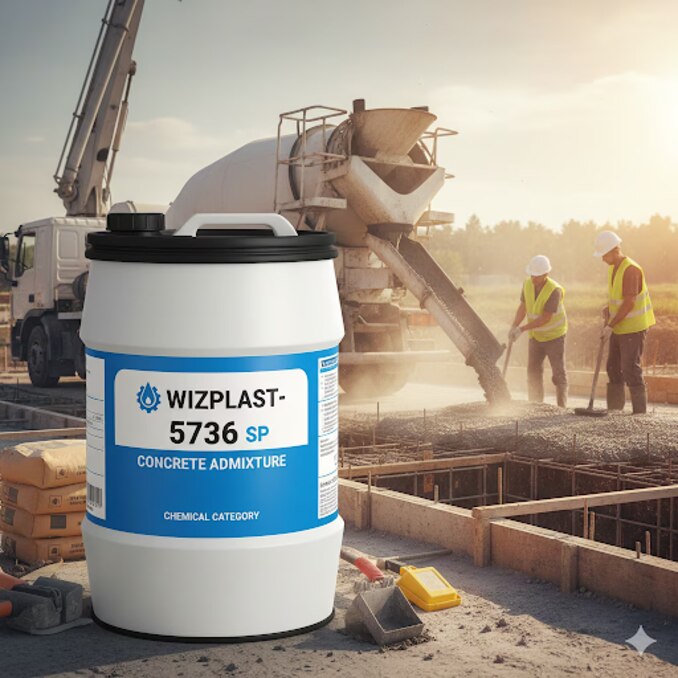
 | CONCRETE ADMIXTURE WIZPLAST-5736 SP is a high-performance superplasticizer admixture specially formulated by Wizplast Chemicals Pvt. Ltd. View product → |
 | CONCRETE ADMIXTURE WIZPLAST - 8427 WZ is a high-performance concrete admixture developed by Wizplast Chemicals Pvt. View product → |
Frequently asked questions
How do you define acceptable concrete flow?
Set the required placing performance before selecting an admixture. Use ordinary slump for conventional concrete and slump flow for highly workable or self-consolidating concrete.
How should you run a field or plant admixture trial?
Use the actual cement, aggregates, water, mixer, batch size, mixing sequence, and placement conditions. Compare slump or slump flow, retention, segregation, setting, finishability, and strength against an untreated or approved reference mix.
How do you set dosage and add the superplasticizer correctly?
Begin within the supplier’s stated dosage range, then adjust through trial batches. Measure the admixture accurately, account for its water content, add it at the tested point in the mixing sequence, and record concrete temperature and workability over time.
Should you choose an SNF or PCE superplasticizer?
Choose SNF when its water reduction and workability retention meet the mix requirement. Choose PCE when you need higher water reduction, extended slump retention, or tighter control of flow, then confirm compatibility through trials.
What evidence should a reliable supplier provide?
Ask for a current technical data sheet, safety data sheet, certificate of analysis or batch test report, recommended dosage range, storage instructions, shelf life, compatibility guidance, and documented trial support.
Related products
 | PCE Based Admixture WIZPLAST - 833 SC is a high-performance PCE (Polycarboxylate Ether) based admixture, specially formulated to enhance the workability, durability, and... View product → |
 | PCE Based Admixture developed by Wizplast Chemicals Pvt. Ltd., is a high-performance PCE (Polycarboxylate Ether) based concrete admixture designed to enhance the quality... View product → |
 | CONCRETE ADMIXTURE WIZPLAST - 1315 UT is a premium-grade concrete admixture developed by Wizplast Chemicals Pvt. View product → |
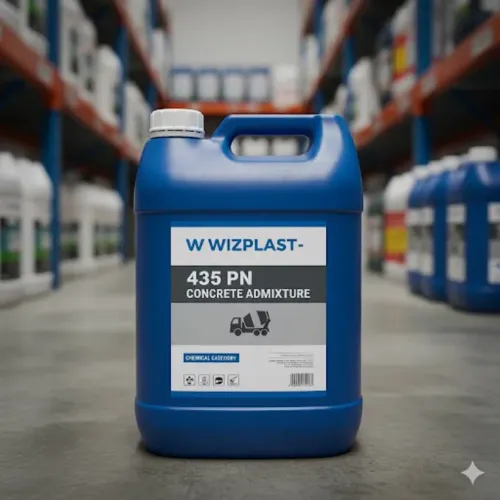
 | PCE Based Admixture WIZPLAST-435 PN is a high-performance PCE (Polycarboxylate Ether) based concrete admixture designed to enhance the workability and durability of... View product → |