Water entering a roof or concrete structure does not identify its own cause: a shrinkage crack, failed joint, porous concrete, plumbing leak, rising damp, condensation, and poor drainage require different responses. By the end, you will be able to diagnose the water path, match the treatment to the location and substrate, and specify application and verification requirements that reduce repeat leakage.
Key takeaways
- Trace staining, dampness, salts, and mould back to the water entry point.
- Match the chemical to cracks, pores, joints, or hydrostatic pressure.
- Remove dust, laitance, oil, and loose concrete before treatment.
- Test the product with your actual concrete mix and site conditions.
Diagnose the Water Path Before Choosing a Chemical
Trace the water path before selecting a chemical. Start inside the building and mark where staining, dampness, salt deposits, or mould appear. Test one small roof area at a time with controlled water, then inspect after rainfall.
A roof can pass ASTM C642 absorption testing or show low ASTM C1202 chloride penetrability while still leaking through cracks, joints, or penetrations.
- Inspect roof cracks, failed joints, pipe penetrations, parapet edges, laps, and outlets before testing the slab surface.
- Check the timing: rain-linked leaks point toward the roof; leaks during water use point toward plumbing; dampness without rain points toward ground moisture or indoor humidity.
- Measure slab moisture and inspect both faces. Trace the highest damp point, not just the lowest stain.
- Check roof drainage for blocked outlets, inadequate falls, ponding, and water marks that show how far water travels.
| Source | Field clue | Confirmation |
|---|---|---|
| Roof cracks | A narrow stain follows a visible fissure | Flood-test the isolated crack area |
| Failed joints | Leakage follows a construction or movement joint | Inspect sealant, waterstop, and joint opening |
| Porous concrete | Broad, uniform dampness without a defined crack | Compare moisture on exposed and protected surfaces |
| Plumbing leaks | Dampness appears below a bathroom, tank, or pipe | Pressure-test the line and isolate fixtures |
| Rising damp | Moisture and salt climb from walls or floors | Test moisture at several heights |
| Condensation | Surface moisture forms during humid conditions | Compare surface and air temperatures |
| Roof drainage | Leaks worsen after ponding or blocked outlets | Clear outlets and repeat a controlled test |
Match the Waterproofing Chemistry to the Failure
A waterproofing chemical succeeds only when its mechanism matches the failure. Low-permeability concrete does not close a moving joint, and a roof coating cannot correct a leaking pipe penetration.
| Option | Best fit | Main limitation |
|---|---|---|
| Integral waterproofing admixture | Reduce capillary permeability throughout new concrete | Does not replace crack, joint, or penetration detailing |
| Cementitious slurry coating | Damp concrete, basements, tanks, and masonry surfaces | Rigid versions do not tolerate active crack movement |
| Acrylic coating | UV-exposed roofs and façades needing a breathable film | Poor choice for regular ponding or wide moving cracks |
| Elastomeric coating | Roof surfaces with minor movement and hairline cracking | Needs sound preparation and reinforcement at larger cracks |
| Crystalline waterproofing | Damp concrete where reactive crystals can block pores and fine dormant cracks | Not a solution for active movement or open joints |
| Silane and siloxane | Repelling rain absorption through exposed façade or concrete pores | Does not bridge cracks or stop pressurised leakage |
| Sealant | Movement joints, isolation joints, and flexible penetrations | Requires correct joint width, backing, and adhesion |
| Injection grout | Leaking cracks, honeycombs, and voids inside concrete | Resin or cement grout must match crack width and water condition |
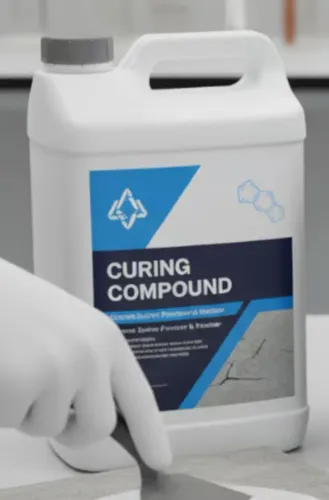
| Curing compound | Protecting fresh concrete while it hydrates and limits early permeability | It is not a waterproofing treatment |
Use a rigid filler or crystalline waterproofing only for suitable dormant cracks. Moving cracks need an elastomeric sealant, flexible membrane reinforcement, or designed joint system. Test an integral waterproofing admixture in the actual concrete mix because it can change slump, setting, air content, and strength development. Remove curing compound residue before applying any coating.
Specify the Treatment by Structure and Water Pressure
Specify the treatment by water pressure and access: positive-side waterproofing protects the concrete directly, while negative-side waterproofing is a remedial choice when water-side access is impossible. Neither low permeability nor an integral admixture replaces crack, joint, penetration, and termination detailing.
| Structure | Appropriate treatment | Pressure and limitation |
|---|---|---|
| Roof slab | Roof slab waterproofing needs a liquid-applied elastomeric membrane tested for crack bridging under ASTM C1305/C1305M, with falls and sealed penetrations. | Use on the positive, weather-facing side; ponding and active cracks require correction. |
| Terrace | Terrace waterproofing uses a UV-resistant membrane beneath a protected finish, with reinforced corners, drains, and upstands. | Treat drainage before coating; a silane or siloxane repellent is not a membrane. |
| Basement | Basement waterproofing uses an external membrane or cementitious/crystalline system against hydrostatic pressure; use negative-side waterproofing only where excavation is impossible. | Interior treatment stops water reaching the room but leaves the concrete saturated on the water side. |
| Retaining wall | Retaining wall waterproofing combines positive-side membrane, protection board, drainage layer, and sealed joints before backfilling. | Do not rely on an interior coating after soil pressure begins. |
| Water tank | A water tank needs a tank-compatible cementitious coating or lining, detailed at joints and tested for leakage before filling. | Select materials approved for the intended water contact. |
| Bathroom | A bathroom needs a flexible cementitious or elastomeric membrane beneath tile, turned into drains and sealed around pipes. | It handles intermittent water, not structural hydrostatic pressure. |
| Façade | A façade with sound concrete may use silane or siloxane to reduce rain absorption while preserving vapour transmission. | These repellents do not bridge cracks or resist positive pressure. |
| Construction joint | Use a waterstop, bonded sealant, or injection grout selected for the joint and pressure. | A surface coat alone leaves the joint as a direct water path. |
| Movement joint | Use a correctly sized elastomeric sealant with backer rod and compatible membrane transitions. | Rigid cementitious coatings crack when the joint opens. |
| Honeycombed concrete | Remove unsound concrete, fill the void with repair mortar, then waterproof the repaired area. | Coating over honeycombed concrete traps a leak behind a weak surface. |
Prepare the Substrate and Control Application Conditions
Bond failure often starts before the waterproofing chemical reaches the concrete. Surface preparation must remove laitance, dust, oil, algae, curing-compound residue, weak concrete, and trapped moisture that blocks penetration or adhesion.
- Mechanically clean and profile the substrate. Complete laitance removal and failed coating removal, then vacuum dust and wash away salts. Do not coat standing water or a damp surface unless the product datasheet specifically permits it.
- Finish crack repair and void filling before waterproofing. Open and repair cracks with the specified resin, sealant, or repair mortar; fill honeycombs, pinholes, tie holes, and surface depressions. Reinstate coves at wall-to-floor junctions and seal penetrations.
- Mix only with the stated water ratio. Measure powder, liquid, and clean mixing water; use a slow-speed mixer for the specified time. Extra water can reduce adhesion, increase shrinkage, and alter setting.
- Apply the specified coverage per square metre and check each coat with a wet-film thickness gauge. Calculate the resulting dry-film thickness after curing; a thick-looking coat does not prove continuous protection.
- Respect the recoat interval, substrate temperature, humidity, and dew-point limits. Record batch numbers, coverage, wet-film thickness, and dry-film thickness for each area.
- Protect the coating during curing from rain, dust, traffic, ponding, and premature loading. Delay backfilling until the system reaches its required cure and install protection boards where soil or aggregate could damage it.
Test adhesion or water exposure on a representative prepared area before full application. Roof drainage must also prevent ponding, because prolonged water exposure finds pinholes and weak terminations.
Verify the Product with the Actual Concrete Mix and Job Details
Do not choose an integral admixture from a catalogue dosage. Select the integral admixture dosage through a trial batch made with the actual cement, supplementary cementitious materials, aggregates, water, and complete admixture package. Record slump, air content, setting time, early strength, and 28-day strength, then repeat after the planned transport and placement interval.
Check cement compatibility with the PCE admixture and other chemicals; a dosage that reduces absorption but causes rapid slump loss or delayed setting is not a workable specification.
| Evidence | What it measures | What it cannot prove |
|---|---|---|
| ASTM C494/C494M | Water reduction, setting control, and strength-related admixture effects | Universal waterproofing performance |
| ASTM C642 | Hardened-concrete density, absorption, and voids | Crack, joint, or membrane watertightness |
| ASTM C1202 | Electrical indication of chloride-ion penetrability | Roof waterproofing or hydrostatic tightness |
| ASTM C1305/C1305M | Crack-bridging ability of liquid-applied waterproofing membrane | Integral-concrete performance |
| ASTM E96 | Water-vapour transmission through a material | Resistance to liquid-water pressure |
Ask Wizplast Chemicals Pvt. Ltd., or any supplier, for test reports using the proposed formulation and application conditions, not a different product family. Require substrate preparation, coverage or thickness, curing conditions, adhesion, and water-exposure results that match the job.
Do not confuse a curing compound versus waterproofing compound: curing retains moisture while concrete gains strength; waterproofing resists water entry. Low permeability still fails at cracks, joints, penetrations, and terminations. Specify the admixture alongside those details, not instead of them.
Related products
 | Waterproofing WIZPLAST IW‐344 is a premium integral waterproofing compound developed by Wizplast Chemicals Pvt. Ltd. View product → |
 | Waterproofing WIZPLAST SHORTCRETE is an advanced waterproofing solution developed by Wizplast Chemicals Pvt. View product → |
Frequently asked questions
How do you diagnose a roof or concrete water leak?
Start inside the structure, mark staining, dampness, salt deposits, and mould, then test small roof areas with controlled water and inspect after rainfall.
How do you choose the right concrete waterproofing chemistry?
Match the treatment to the failure: use a chemistry suited to pores, cracks, construction joints, or active water pressure rather than selecting by product name alone.
What should you consider when specifying waterproofing treatment?
Consider the structure, exposure, crack condition, substrate, and water pressure, including whether water is pushing from the positive or negative side.
How should concrete be prepared before waterproofing?
Remove dust, laitance, oil, coatings, and loose concrete; open and repair defects; then control surface moisture, temperature, mixing, and curing during application.
Related products
 | Waterproofing WIZCOAT WP-2 by Wizplast Chemicals Pvt. Ltd. is a high-performance waterproofing compound specially formulated to provide long-lasting protection... View product → |
 | Waterproofing Wizplast Chemicals Pvt. Ltd. offers premium-quality Curing Compounds and Sealants designed to deliver superior waterproofing and surface protection... View product → |
 | Waterproofing by Wizplast Chemicals Pvt. Ltd. is an advanced acrylic-based waterproofing coating specially designed to protect surfaces from water seepage,... View product → |
 | Waterproofing WIZPLAST WB-47 is a premium-grade water-based waterproofing solution developed by Wizplast Chemicals Pvt. View product → |