Leakage rarely comes from one failed product: water follows joints, cracks, penetrations, porous concrete, and poorly prepared surfaces. By the end, you will know how to classify the exposure, choose a compatible waterproofing form, demand a site trial, check installation quality, and troubleshoot defects before they disappear behind finishes.
Key takeaways
- Identify the water source, pressure, movement, and receiving face before choosing a compound.
- Match cementitious, liquid, or repair compounds to the task and substrate condition.
- Run a supplier-reviewed site trial before applying waterproofing across the full area.
- Inspect, test, and document curing before covering the treated surface.
Start with the Water Path and the Acceptance Test
Trace where water comes from, how it moves, and which face of the assembly will receive the compound before selecting it. Mark whether the risk is basement hydrostatic pressure, roof rainwater, wet-area splash, rising damp, a leaking construction joint, an active crack, or absorption through porous concrete.
Record water pressure, exposure frequency, substrate condition, drainage, and whether access is available on the water-facing side.
| Exposure condition | Water path and pressure | Acceptance test |
|---|---|---|
| Basement hydrostatic pressure | Water pushes through soil-facing walls or slabs | Visual inspection, pressure testing, and documented repair of seepage |
| Roof rainwater | Intermittent surface flow and ponding at falls or drains | Controlled ponding or flood test after curing |
| Wet-area splash | Repeated local wetting at floors, corners, and penetrations | Flood test, visual inspection, and dry-side leak check |
| Rising damp | Capillary movement from ground through masonry or slab edges | Moisture mapping, absorption testing, and inspection after drying |
Specify acceptance by location and method; “waterproof” alone is not a pass criterion. A coating on the positive side stops water before it enters concrete and is easier to protect. A negative-side system faces water pressure pushing it away from the substrate, so adhesion, crack treatment, vapour transmission, and drainage become critical.
Ask the supplier to state the test duration, water depth or pressure, curing period, permitted dampness, and repair procedure. ASTM C494/C494M admixture classes describe water-reduction performance, not crack resistance or watertightness.
Match the Product Form to the Repair or Protection Task
A product form is unsuitable if it cannot remain bonded under the site’s water pressure or cannot move with the defect. Match the material to whether water attacks from the protected side or the dry side, then confirm the crack, joint, and substrate conditions.
| Option | Best fit | Main limitation |
|---|---|---|
| Integral waterproofing admixture | New concrete exposed to capillary moisture and permeability concerns | Does not replace crack injection, waterstops, or movement-joint sealants |
| Cementitious treatment | Concrete or masonry with pores, damp surfaces, and positive- or negative-side protection needs | Rigid areas and active cracks need separate treatment |
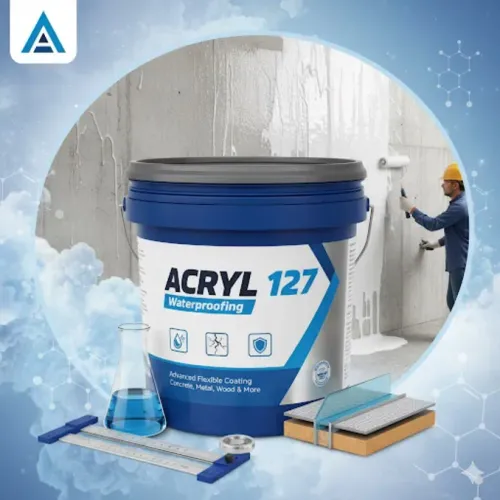
| Acrylic coating | Above-grade walls, roofs, and façades needing weather and UV protection | Poor choice for sustained hydrostatic pressure unless the complete system is rated for it |
| Water-based coating | Low-odour protection where the substrate is dry enough for the specified film to cure | “Water-based” describes the carrier, not proof of pressure resistance |
Positive-side waterproofing blocks water before it enters the concrete and is easier to protect. A negative-side coating faces water pushing it away from the substrate, so adhesion, vapour transmission, drainage, and crack treatment become critical.
Ask the supplier to identify the exact exposure and provide a data sheet stating application side, pressure rating, crack-bridging capacity, curing conditions, and compatible primers or sealants. Do not treat an ASTM C494/C494M Type A, D, F, or G designation as waterproofing approval; it classifies concrete-admixture performance, not watertightness or crack resistance.
Use the Supplier’s Technical Review and Site Trial
Approve the compound only after the supplier matches it to the actual exposure and construction method. The technical data sheet must state dosage, application limits, curing requirements, and restrictions; the safety data sheet must identify hazards, handling, storage, and spill controls. Request product identification, lot-specific certificate of analysis, shelf-life, and storage limits.
- Inspect the delivered material before dosing. Check seals, batch number, appearance, and separation. Liquid admixtures can freeze, become contaminated, or separate; powder compounds can cake after moisture exposure. Reject material that fails the supplier’s stated condition limits.
- Confirm cement compatibility using the project’s cement, slag or fly ash, aggregates, and other admixtures. Changes in sulfate or alkali balance, temperature, or polycarboxylate chemistry can alter slump retention, air content, setting time, and finishing at the same nominal dosage.
- Run a trial batch, not just a slump check. Record water-cementitious materials ratio, air content, density, setting time, compressive strength, and the specified transport or absorption result. Treat ASTM C1202 as an indication of ionic transport, not a direct leakage test.
- Place a representative mock-up with real joints, penetrations, congested reinforcement, lift heights, waterstops, and curing method. Include the proposed PVC or elastomeric waterstop, hydrophilic strip, injection hose, or sealant system.
- Confirm whether the system is positive-side or negative-side. Negative-side coatings need evidence of adhesion, vapor tolerance, crack treatment, and drainage under water pressure.
Wizplast Chemicals Pvt. Ltd. can support this review by supplying project-specific documentation and trial guidance rather than approving a product from a flat laboratory panel alone. Release full-scale placement only after the mock-up achieves the agreed acceptance test.
Related products
 | Waterproofing WIZPLAST IW‐344 is a premium integral waterproofing compound developed by Wizplast Chemicals Pvt. Ltd. View product → |
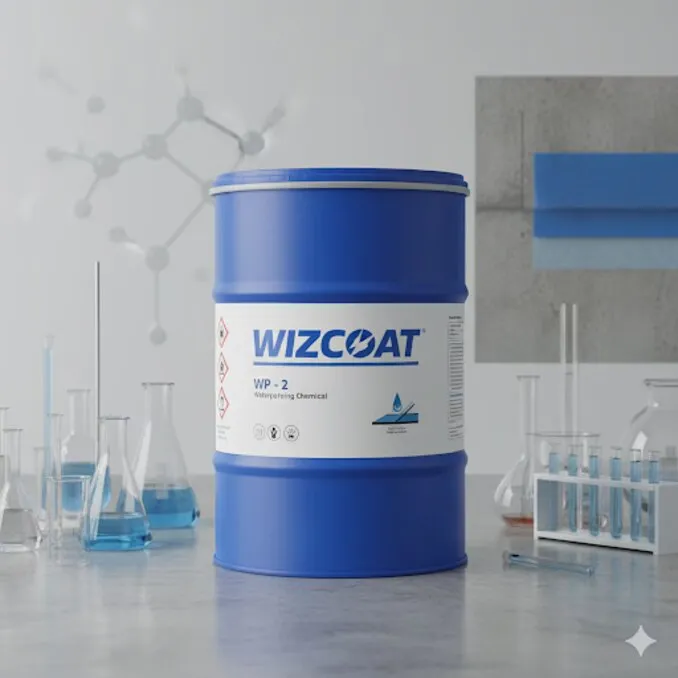
 | Waterproofing WIZCOAT WP-2 by Wizplast Chemicals Pvt. Ltd. is a high-performance waterproofing compound specially formulated to provide long-lasting protection... View product → |
Control Surface Preparation and Application Variables
Install a surface-applied waterproofing system by controlling the substrate, joint details, mix, placement, thickness, and cure as one sequence. A coating over weak concrete will peel or leave pinholes, even when the product is suitable.
- Complete surface preparation by removing laitance, dust, oil, efflorescence, loose concrete, and failed coatings. Expose sound material without polishing the surface.
- Inspect construction joints for sound stop-end geometry, exposed aggregate where specified, cleanliness, and correctly positioned waterstops. A coating cannot restore continuity through a badly prepared joint.
- Carry out crack treatment before coating. Open static cracks to a sound profile and fill them with the specified repair material; route active leaks to a compatible injection or plugging system. Do not expect a coating to seal moving joints or penetrations.
- Follow the product instructions for prewetting, primer, or bonding slurry. A dry substrate can draw water from a cementitious coating and cause poor adhesion.
- Mix only the stated water quantity and observe the pot life. Apply the specified coats uniformly, checking wet-film thickness with a gauge rather than estimating coverage from container count.
- Protect the fresh layer from rain, rapid evaporation, freezing, vibration, and traffic. Maintain the stated curing period before backfilling, immersion, or covering.
Confirm whether the system is on the positive or negative side of water pressure. Negative-side application needs particular attention to adhesion, vapor movement, crack treatment, and drainage because pressure pushes the coating away from the concrete.
Use a site trial to verify coverage, bond, detailing, and curing under actual temperature and humidity before full application.
Inspect, Test, Cure, and Troubleshoot Before Concealment
Before covering the work, require a representative mock-up that includes actual construction joints, penetrations, congested reinforcement, lift heights, waterstops, and the specified curing method. A flat test panel will not expose poor consolidation, honeycombing, or gaps around embedded items.
Use each test for the failure mode it can reveal:
| Test | What it reveals | Check before concealment |
|---|---|---|
| Visual inspection | Pinholes, cracks, blisters, debonded areas, exposed reinforcement, and incomplete waterstop continuity | Inspect every treated surface and joint |
| Ponding test | Surface leakage through roofs, balconies, wet areas, and tanks | Control water depth and duration; record damp spots below |
| Water-pressure test | Leakage under hydrostatic pressure in tanks, basements, and retaining structures | Test after the system reaches its specified cure |
| Adhesion test | Weak bonding or coating detachment, especially on negative-side applications | Test representative locations, including repairs and joints |
A construction-joint inspection must confirm stop-end geometry, laitance removal, sound exposed aggregate where specified, cleanliness, prewetting or bonding treatment, and correct waterstop placement. A surface coating cannot restore continuity through a badly prepared joint.
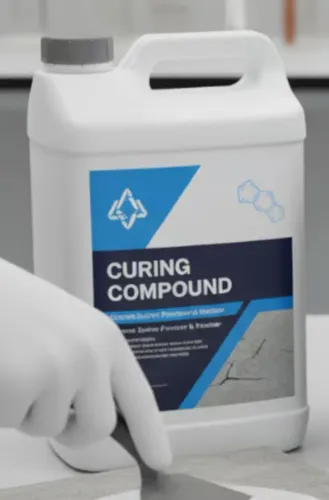
Record the curing compound, batch number, application rate, placement temperature, and cure duration. Inadequate curing leaves porous concrete and shrinkage cracks that defeat a suitable waterproofing compound.
Before handover, mark every leak and classify it as a crack, joint, porous concrete, penetration, or coating failure. Repair active leaks and defects, repeat the applicable test, and keep photographs and test results before backfilling, screeding, tiling, or insulation conceals the evidence.
Frequently asked questions
How do you choose a waterproofing compound for a construction project?
Trace the water path first, then match the compound form to the leak source, substrate, pressure, movement, and receiving face.
Why use a supplier technical review and site trial?
A technical review checks product suitability, while a site trial exposes preparation, mixing, application, and compatibility problems before full-scale work.
Which application variables affect waterproofing performance?
Surface preparation, substrate moisture, mixing proportions, coat thickness, application conditions, curing, and protection from damage all affect performance.
What should you check before concealing a waterproofed area?
Inspect the finished treatment, complete the specified water or flood test, confirm curing, record defects, and repair failures before covering the work.
Related products
 | Waterproofing Wizplast Chemicals Pvt. Ltd. offers premium-quality Curing Compounds and Sealants designed to deliver superior waterproofing and surface protection... View product → |
 | Waterproofing WIZPLAST WB-47 is a premium-grade water-based waterproofing solution developed by Wizplast Chemicals Pvt. View product → |
 | Waterproofing WIZPLAST SHORTCRETE is an advanced waterproofing solution developed by Wizplast Chemicals Pvt. View product → |
 | Waterproofing by Wizplast Chemicals Pvt. Ltd. is an advanced acrylic-based waterproofing coating specially designed to protect surfaces from water seepage,... View product → |