Concrete loses moisture fastest when finishing is delayed, bleed water is trapped under a film, or wind and sun dry exposed faces before curing begins. You will be able to compare curing methods, calculate the material required, specify supplier evidence, and check that the applied membrane is continuous.
Key takeaways
- Apply compound after bleed water and surface sheen disappear.
- Match the curing method to concrete, weather, and the next finish.
- Demand coverage rate, drying time, and compatibility data from suppliers.
- Inspect film coverage and record weather, equipment, batch, and application details.
Start curing when the surface is ready, not when the clock says so
Apply curing compound after finishing is complete, the visible surface sheen has disappeared, and bleed water is gone. The surface must accept the spray without being marred by the applicator or spray pressure.
That is the practical answer to when to apply curing compound; elapsed hours are only a guide because wind, temperature, mix design, and finishing method change the timing.
Cover every exposed concrete surface, not only the horizontal slab:
- Spray the slab top at the specified coverage rate, maintaining a continuous, uniform film.
- Coat slab edges and joints, including construction-joint faces, immediately after forms or joint materials expose them.
- Treat formed faces and vertical walls after form removal; do not leave them to dry while the top is being covered.
- Seal exposed areas around repairs, penetrations, openings, and irregular corners with the same continuous membrane.
Missed edges lose moisture quickly because they have a high surface-area-to-volume ratio. A well-coated top cannot compensate for an untreated joint face.
If rain strikes before the film has dried, protect the area and inspect it after the surface is stable. Reapply where water has thinned, washed away, or interrupted the membrane.
In hot, dry, or windy weather, use shading, windbreaks, or evaporation control as well; curing compound reduces moisture loss but does not prevent plastic-shrinkage cracking caused by rapid evaporation.
Match the curing method to the concrete and the next finish
A bonded coating or tile topping changes the choice: use a curing method that preserves moisture without leaving a bond-breaking residue. Match the method to the placement, exposure, and finish that follows.
| Option | Best fit | Planned finish | Main risk |
|---|---|---|---|
| Membrane-forming curing compound | Large slabs, walls, and exposed vertical faces where wind, heat, or limited water access threatens rapid drying | Bare concrete or a finish confirmed compatible with the film | Residue, pinholes, or poor adhesion if applied over bleed water |
| Water curing | Flat slabs with reliable continuous water supply and drainage | Finishes that tolerate saturated concrete and adequate drying time | Interrupted wetting or trapped moisture delays the next operation |
| Wet coverings | Slabs and repairs needing direct moisture retention, especially in hot or windy weather | Finishes scheduled after the concrete dries fully | Cover movement, exposed edges, and uneven moisture create patchy curing |
| Polyethylene sheets | Small or accessible placements where sheets can lie tightly against the surface | Bare concrete after sheet removal | Wrinkles leave dry stripes; condensation can delay coatings |
| Curing-and-sealing compound | Exposed floors requiring early curing plus dust resistance | Only a coating or topping approved for that resin | “Sealing” does not prove overlay compatibility |
For a conventional compound, ask for an ASTM C156 report supporting ASTM C309’s 0.55 kg/m² water-loss limit. ASTM C1315 sets a tighter 0.40 kg/m² limit, but compliance still does not guarantee adhesion beneath your planned coating.
Treat water curing and wet coverings as better choices when residue could compromise a bonded finish. In hot, dry, or windy exposure, add shade, windbreaks, or evaporation control; no curing compound corrects poor proportioning or uncontrolled cracking.
Demand application data before comparing suppliers or prices
A litre price is meaningless without a verified coverage rate, solids content, and application method. Before comparing suppliers, request documents that show how the compound performs and how much your actual concrete will consume.
1. Request the current test report supporting ASTM C309 or ASTM C1315. ASTM C309 permits water loss of 0.55 kg/m² under ASTM C156; ASTM C1315 limits it to 0.40 kg/m². A data-sheet claim alone is not evidence.
2. Record the resin and wax type, polymer or solvent base, nonvolatile solids percentage, colour, dilution instructions, shelf life, and storage-temperature range. A clear film can simplify appearance, while white pigment helps expose missed areas.
3. Obtain the supplier’s coverage rate in m²/L, including its wet-film or application-rate basis. Do not use the ASTM test application rate as your site rate: rough, porous, broom-finished, and absorptive concrete consumes more.
4. Get the spray-nozzle specification, pressure range, number of coats, recoat interval, drying time, minimum application temperature, and rain-resistance time. Cold, humid conditions or rain before film formation can leave discontinuities.
5. Demand compatibility evidence for your actual epoxy, polyurethane, bonded topping, tile adhesive, or resilient-flooring adhesive. ASTM C309 or ASTM C1315 compliance does not remove resin, wax, or polymer residue.
Calculate litres as concrete area divided by the stated site coverage rate, then add a measured allowance for overspray, absorption, edges, and interruptions. For 1,000 m² at 5 m²/L, the base order is 200 L; Wizplast Chemicals Pvt. Ltd. should provide the same application and compatibility data before its quotation enters that comparison.
Related product
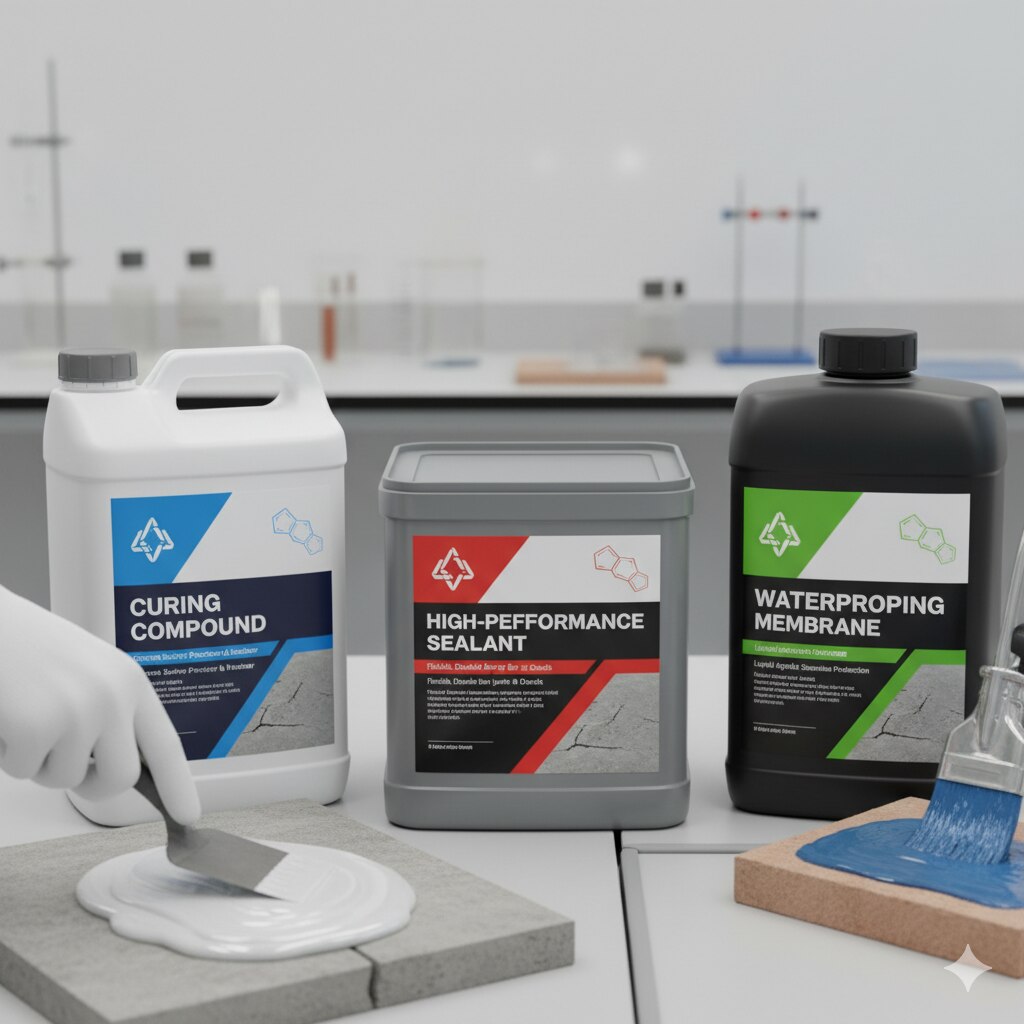 | Waterproofing Wizplast Chemicals Pvt. Ltd. offers premium-quality Curing Compounds and Sealants designed to deliver superior waterproofing and surface protection... View product → |
Control weather, equipment, and interruptions during application
Do not spray onto visible bleed water. Wait until finishing is complete, the surface sheen has disappeared, and the concrete accepts the spray without tearing or marking; spraying earlier dilutes the film and creates pinholes.
1. Read the forecast before starting. A hot wind or low humidity accelerates evaporation, so use windbreaks, shading, or evaporation-control measures and apply promptly. A white-pigmented curing compound reduces solar heating on exposed slabs; a clear product with fugitive dye only helps you see coverage.
2. Condition the concrete before application. Remove standing water, repair damaged edges, and plan separate passes for slabs, walls, vertical faces, recesses, and patched areas. A curing compound cannot compensate for excessive bleed water, poor finishing, or plastic-shrinkage cracking.
3. Prepare the spray equipment exactly as the supplier specifies. Agitate or continuously recirculate water-based pigmented material so settled solids do not block the nozzle, but avoid high-speed mixing that entrains air or damages the emulsion. Use the stated nozzle, pressure, coverage rate, and overlapping passes; brush tight edges and inaccessible repairs.
4. Stop immediately if rain begins before the film sets. Protect the surface from rainfall without touching the wet membrane, then wait for the concrete and repaired areas to dry. Check for washout or discontinuity, and reapply only under the product’s minimum temperature, drying-time, and rain-resistance requirements.
Cold, humid conditions and damp concrete extend drying time.
Inspect the film and record what happened on site
Confirm the film is continuous, opaque where a white-pigmented product was specified, and in a tack-free condition before allowing traffic or placing the next operation. A glossy, patchy, dusty, or sticky surface signals incomplete film formation, not successful curing.
Inspect the slab top, edges, formed faces, construction-joint faces, corners, repair areas, and around penetrations. Edge and joint surfaces dry quickly even when the horizontal surface shows uniform coverage.
- Look for pinholes, bare strips, lap marks, runs, puddles, overspray, and areas blocked by equipment or finishing tools.
- Check that the film was not diluted beyond the supplier’s written instruction and that the spray pattern produced the stated coverage rate.
- Mark locations where rain struck before the specified rain-resistance time, or where wind carried spray away.
- Reinspect traffic routes and repaired surfaces for scuffing, peeling, powdering, or exposed concrete; reapply only as the product instructions permit.
Record the application date and time, concrete surface condition, air and concrete temperatures, wind, rain, equipment, nozzle setting, coverage achieved, and start and finish times. Add the product name, batch number, applicator, affected areas, interruptions, corrective work, and photographs to the inspection records.
A visual inspection cannot prove water retention. Keep the supplier’s current ASTM C156 report for the product and application rate; ASTM C309’s limit is 0.55 kg/m² over the test period. Jobsite texture and absorption can require more material than the laboratory panel.
Frequently asked questions
When should you apply concrete curing compound?
Apply it after finishing is complete, bleed water is gone, and the visible surface sheen has disappeared. The surface must accept spraying without damage from the applicator or spray pressure.
How do you choose the right curing method?
Match the method to the concrete mix, site conditions, required curing performance, and the next finish. Confirm that the compound will not interfere with coatings, tiles, overlays, or other planned treatments.
What application data should you request from a curing compound supplier?
Request the recommended coverage rate, application method, drying time, temperature limits, recoat or removal instructions, compatibility information, and product batch details.
What should you inspect after applying curing compound?
Check that the film covers the surface continuously without missed strips, pooling, bare patches, or excessive spray. Record the product batch, application time, weather, equipment, coverage, and interruptions.