A product name and a low price per litre do not show whether an admixture will control slump, setting, air content and strength with your cement, aggregates and supplementary cementitious materials. Use a documented supplier scorecard, request verifiable product data, run a controlled plant trial and compare delivered cost per cubic metre before approving a source.
Key takeaways
- Verify who controls formulation, testing, traceability and change management.
- Request technical data sheets, safety data sheets, batch records and conformity documents.
- Compare dosage, setting time and strength results against named standards.
- Run trials with your cement, aggregates, water, weather and delivery schedule.
Build a supplier shortlist around traceability and technical support
A dependable supplier can trace every drum or tank load back to a manufacturing site, raw-material batch and production date. Ask whether you are dealing with a manufacturer versus distributor, a stockist, or a private-label seller; the label alone does not reveal who controls formulation, testing or change management.
Use this shortlist test:
- Manufacturer: provides a lot-specific certificate of analysis, retain samples, formulation-change notices and direct technical escalation.
- Distributor: names the original manufacturer and preserves its batch records, storage controls and complaint route.
- Stockist: proves that inventory stayed within the stated temperature, shelf-life and rotation limits.
- Private-label seller: identifies the actual producer and accepts responsibility for requalification after a source or formulation change.
Do not approve a concrete admixture supplier on a batch certificate alone. That document can confirm density, pH, solids or identity against an internal specification; it cannot prove your concrete will achieve strength, setting, air content or slump retention.
Require a current technical data sheet, safety data sheet, certificate of analysis, batch number, manufacturing date, retain sample and written change-notification rule.
Score technical support by evidence: named laboratory capability, response time for site problems, a defined complaint investigation, and a requalification trigger for changes in formulation, raw materials or manufacturing location. For reinforced or prestressed concrete, require a numerical chloride declaration and calculate its contribution at the proposed dosage.
Finally, make delivery part of qualification. Put minimum remaining shelf life, lot identification, emergency replenishment time and responsibility for expired or changed stock into the supply agreement.
Request the documents and product data that make comparison possible
Require a current technical data sheet, safety data sheet, certificate of analysis, batch number and manufacturing date before approval. The documents must identify the product’s exact test standard, not merely claim “high performance.” Use ASTM C494 when applicable; use ASTM C1017/C1017M for a plasticizing admixture intended for flowing concrete with relatively low water content.
Request these records from the supplier:
- Recommended dosage range, density, pH, chloride content, alkali content, solids content and viscosity
- Compatibility data for your cement, supplementary cementitious materials and other admixtures
- Shelf life, storage temperature limits, freezing limits, tank-material compatibility and instructions for settling, separation, agitation or frozen product
- Retain-sample policy, lot traceability, formulation-change notifications and the requalification trigger for a changed raw-material source or manufacturing location
| Document or property | What it proves | What it does not prove |
|---|---|---|
| Certificate of analysis | The supplied batch meets the supplier’s internal limits for identity and measured properties | Strength, setting, air, permeability or slump retention in your concrete |
| Technical data sheet | Declared dosage, chemistry-related limits, standards and handling conditions | Performance after your actual haul and placement time |
| Trial data | Initial and discharge-age slump, setting, air and strength under plant conditions | That every future batch will perform without lot control |
Treat initial slump and slump retention as separate requirements. Require test results at batching and at the specified or worst-case discharge age, then define acceptable limits for setting time, air content, bleeding and early strength. A batch number without a retained sample leaves a failed load difficult to investigate.
Compare performance with standards, not with marketing adjectives
Judge applicability by matching the published test conditions to your concrete specification, not by accepting “premium” or “next-generation” as evidence. A product’s classification identifies the performance category; it does not prove compatibility with your cement, supplementary cementitious materials, temperature, air target, or delivery time.
| Standard | What it evaluates | Procurement implication |
|---|---|---|
| ASTM C494/C494M | Water-reducing, retarding, accelerating, high-range water-reducing and related admixture types | Use the specified Type A, D, E, F, G or S classification and acceptance requirements |
| ASTM C1017/C1017M | Plasticizing admixtures for flowing concrete made with relatively low water content | Use this standard when flowing concrete is the application; do not substitute C494 merely because both products increase slump |
| ASTM C260/C260M | Air-entraining admixtures | Treat air performance separately from water-reducer classification |
Require the supplier to identify the exact standard, admixture type, test dosage, cementitious materials, temperature, initial slump and test ages behind every published result. Type A or Type F performance alone does not establish the required water reduction or slump retention duration for your mix.
Set acceptance values for the actual specification, including:
- Water reduction at the proposed dosage
- Slump at batching and at the specified discharge age
- Setting time, strength development and air content
- Declared chloride content and its calculated contribution at dosage
- Test method, laboratory conditions and any deviation from the named ASTM standard
A certificate confirms conformance to a stated product specification; it does not prove project performance. Treat laboratory air content as indicative, because aggregate grading, mixer operation, temperature and haul time can change field results.
Run a plant trial using your actual materials and delivery conditions
Run paired batches with the plant’s actual cement, fly ash and GGBS, aggregates, mix water and production equipment. The control mix must use the currently approved admixture or no admixture, while the trial mix uses the candidate at its proposed dosage; keep the cementitious content and target water-cementitious ratio constant.
1. Correct aggregate moisture before batching. Record aggregate temperatures, cementitious materials, water temperature, ambient temperature, batch weights, mixer type and mixing time. A moisture error can falsely make an admixture appear effective.
2. Produce enough concrete to represent production, not a small laboratory sample. Record the candidate’s addition point, dosing sequence and time from water contact to discharge. Do not premix concentrates or combine dispensing lines unless the manufacturer permits it.
3. Measure slump, concrete temperature, air content and density at batching. Repeat those measurements at the expected and worst-case discharge ages, such as 60 and 120 minutes, using the plant’s actual haul route and truck rotation. Use ASTM C231 or ASTM C173/C173M for air measurement as appropriate.
4. Compare water reduction, initial slump, slump retention, bleeding, segregation, finishability and setting time against the control mix. Check cement compatibility across the project’s cementitious system; changes in sulfate balance, alkali content, fineness or grinding aids can alter performance.
5. Repeat the trial at the selected dosage and at nearby dosages if results are marginal. Accept the product only when it meets the specified slump at discharge without unacceptable retardation, air variation or batch-to-batch instability.
Have the supplier review the batch records and investigate any failure before approval. A certificate from a generic cement test cannot replace this plant trial.
Turn trial results into a supply, storage and service decision
Approve the chemistry that meets the discharge-age target at a predictable dosage, not the one with the lowest drum price. Compare PCE versus naphthalene and melamine on cost per cubic metre, including rejected loads, extra cement or water, slump-adjustment visits, cleaning, tank calibration and downtime.
| Option | Strength | Main procurement risk |
|---|---|---|
| PCE | Lower water demand and adjustable slump retention | Overdose can cause segregation, air changes, retardation or delayed strength |
| Naphthalene | Familiar handling and established plant experience | Faster slump loss can increase re-dosing, rejected loads and water temptation |
| Melamine | Strong early dispersion in suitable mixes | Performance can fall outside its tested cement and haul-time conditions |
Set a documented dosage range for the approved mix and require written instructions for adjustments within that range. Record initial slump, discharge-age slump, setting behaviour, air content and strength; do not approve a product on initial slump alone.
Storage is part of performance. Put temperature limits, shelf life, tank-material compatibility, agitation rules, separation or freezing procedures and minimum remaining shelf life at delivery into the supply agreement. Match delivery frequency to consumption so seasonal demand does not turn stock into expired waste.
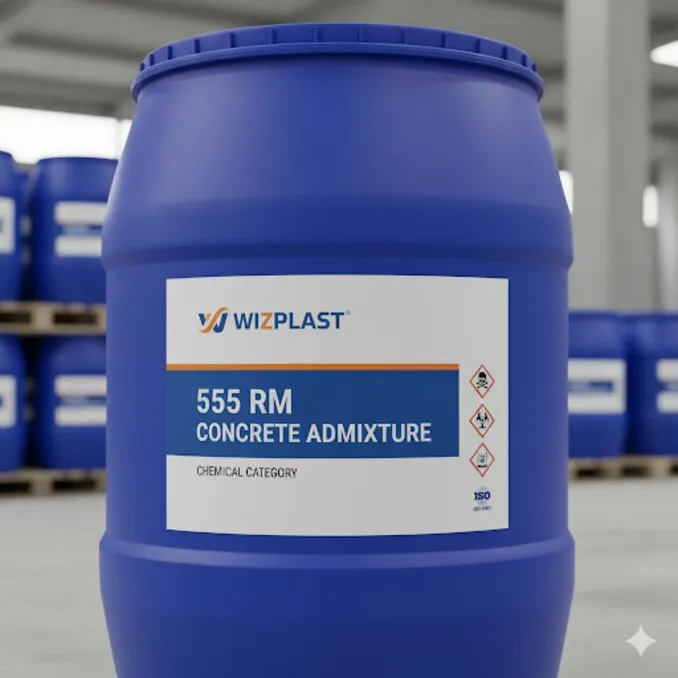
For a product range from Wizplast Chemicals Pvt. Ltd., request the same batch-level dosage, storage and compatibility evidence as for every competing supplier.
Make complaint response measurable: name the technical contact, define the response time, preserve the affected batch and delivery records, and assign responsibility for site investigation, replacement material and unusable stock. Require lot identification and emergency replenishment time before approving regular supply.
Related products
 | PCE Based Admixture WIZPLAST - 833 SC is a high-performance PCE (Polycarboxylate Ether) based admixture, specially formulated to enhance the workability, durability, and... View product → |
 | CONCRETE ADMIXTURE WIZPLAST - 8427 WZ is a high-performance concrete admixture developed by Wizplast Chemicals Pvt. View product → |
Frequently asked questions
How should you shortlist a concrete admixture supplier?
Check whether the supplier is a manufacturer, distributor, stockist or private-label seller, then verify traceability, formulation control, testing and technical support.
Which documents should you request before comparing admixtures?
Request the technical data sheet, safety data sheet, batch certificate, product specification, storage instructions, shelf life and documents showing conformity with the specified standard.
How do you compare concrete admixture performance?
Compare measured dosage, slump retention, setting time, water reduction, air content and strength against named standards and your project requirements, not marketing adjectives.
What should a ready-mix plant trial include?
Use your actual cement, aggregates, mixing water, admixture dosage, batch sequence, delivery distance, ambient conditions and placement schedule, then record fresh and hardened concrete results.
Related products
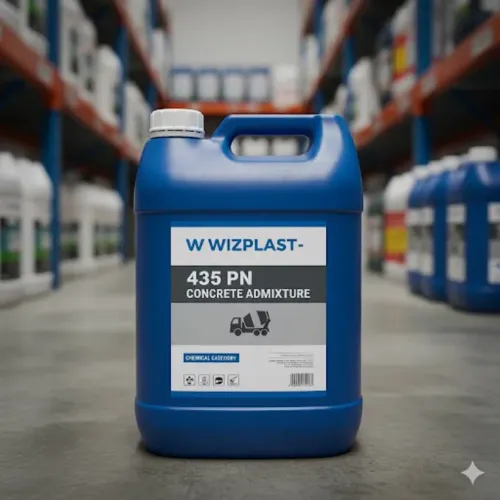
 | CONCRETE ADMIXTURE WIZPLAST-435 PN, offered by Wizplast Chemicals Pvt. Ltd., is a high-performance concrete admixture designed to enhance the workability, strength, and... View product → |
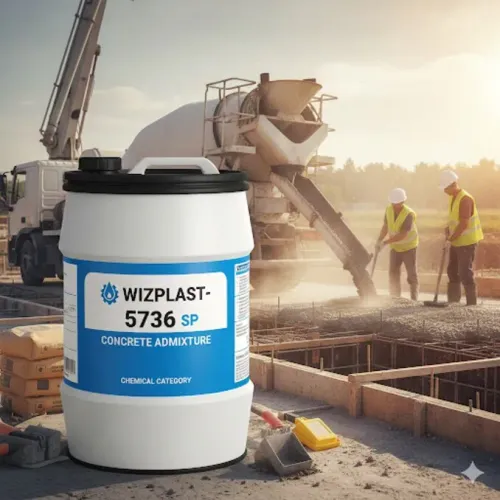
 | CONCRETE ADMIXTURE WIZPLAST-5736 SP is a high-performance superplasticizer admixture specially formulated by Wizplast Chemicals Pvt. Ltd. View product → |
 | PCE Based Admixture developed by Wizplast Chemicals Pvt. Ltd., is a high-performance PCE (Polycarboxylate Ether) based concrete admixture designed to enhance the quality... View product → |
 | CONCRETE ADMIXTURE WIZPLAST - 1315 UT is a premium-grade concrete admixture developed by Wizplast Chemicals Pvt. View product → |