
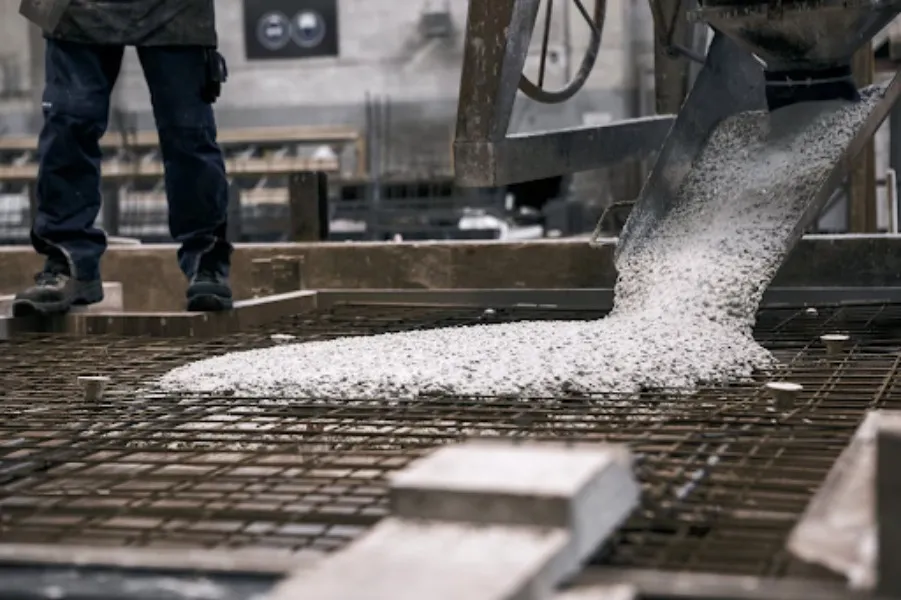
Concrete placement does not always happen under ideal conditions. High temperatures, large pours, long transportation distances, and complex structural designs can cause concrete to set faster than expected. In such situations, a Concrete Retarder becomes an important solution for maintaining workability and ensuring proper placement.
For construction projects across Mumbai, where traffic delays and warm weather often affect ready-mix concrete delivery, understanding when to use retarders can help prevent costly site issues.
What Is a Concrete Retarder?
A concrete retarder is a chemical admixture that slows the setting time of concrete without significantly affecting its long-term strength when used correctly.
By delaying hydration, contractors gain additional time for transporting, placing, compacting, and finishing concrete.
Situations Where a Retarder Becomes Necessary
Several project conditions indicate that a retarder may be beneficial.
Long Transportation Distances
Concrete transported over extended distances may begin setting before reaching the site.
A retarder helps preserve workability until placement.
Hot Weather Construction
Higher temperatures accelerate cement hydration.
Retarders help offset this effect by extending workable time.
Large Concrete Pours
Mass concreting operations require continuous placement.
Retarders reduce the risk of cold joints forming between successive pours.
Complex Reinforcement
Structures with congested reinforcement often require additional placement time.
Slower setting allows concrete to flow more effectively before hardening.
Advantages of Using Concrete Retarders
When selected appropriately, retarders provide several benefits.
These include:
- Improved workability
- Better surface finishing
- Reduced risk of cold joints
- Easier pumping
- Greater flexibility during placement
- Improved construction quality
These advantages become particularly valuable on large commercial and infrastructure projects.
Important Considerations
Retarders should always be selected based on project requirements.
Factors influencing selection include:
- Cement type
- Ambient temperature
- Concrete grade
- Transportation duration
- Desired setting time
- Structural specifications
Laboratory testing helps establish the correct dosage before production.
Common Misconceptions
Some believe retarders reduce concrete strength.
In reality, when properly formulated and dosed, quality retarders primarily affect setting time while allowing concrete to achieve its intended mechanical properties.
Incorrect dosage or incompatible products are usually responsible for performance issues.
Why Technical Guidance Matters
Construction chemicals should never be selected solely by comparing product names.
Experienced manufacturers assist contractors in choosing formulations suited to local conditions and project requirements.
Companies such as Wizplast Chemicals Pvt. Ltd. provide technical guidance alongside construction chemical solutions, helping contractors optimise concrete performance across projects in Mumbai and Maharashtra.
Planning Concrete Placement More Effectively
Knowing when to use a Concrete Retarder allows project teams to maintain better control over concrete placement, especially under demanding site conditions. Proper planning, compatibility testing, and manufacturer support help ensure successful construction outcomes.
Keywords