A PCE product is not a universal solution: its response changes with cement chemistry, supplementary cementitious materials, temperature, transport time, and mixing sequence. By the end, you will have a practical way to specify trials, compare suppliers, and confirm that a PCE works under the conditions your project will actually face.
Key takeaways
- Compare polymer chemistry and solids content, not dosage labels alone.
- Set dosage through laboratory testing followed by controlled field trials.
- Test cement, supplementary materials, and PCE compatibility before the pour.
- Document trial results as measurable project acceptance criteria.
A PCE Product Name Is Not a Performance Specification
Two liquid PCE products can carry the same dosage recommendation and produce different concrete. Polycarboxylate ether chemistry changes with the polymer backbone, side-chain length, grafting density, solids content, and functional groups, affecting water reduction, slump retention, setting, air entrainment, and cement sensitivity.
ASTM C494 separates high-range water reducers into Type F, without set retardation, and Type G, with retardation; both must achieve at least 12% water reduction in the specified test. That classification does not tell you whether the admixture will meet your high-performance concrete targets.
Commodity superplasticizer purchasing compares containers. A capable PCE based admixture supplier helps you compare delivered performance.
| Commodity superplasticizer | Supplier-supported PCE selection |
|---|---|
| Liquid dosage | Active-polymer solids and liquid dosage |
| Initial slump | Initial water reduction and workability |
| Transport | Slump retention through delivery and pumping |
| Storage | Stated temperature range, shelf life, agitation, and freeze-recovery limits |
| Production | Batch consistency and troubleshooting support |
Ask for evidence tied to your mix, not a brochure claim:
- Active-solids content and recommended dosage range
- Trial data for water-binder ratio, early strength, 28-day strength, setting time, and pumping distance
- Cement-specific compatibility results and the required addition sequence
- Storage limits and instructions after freezing, overheating, contamination, or prolonged storage
A supplier that cannot explain why two batches respond differently leaves you to diagnose chemistry during a pour. That risk matters more than a small difference in liquid price.
Set the Dosage Through Laboratory and Field Trials
Start with a laboratory trial that brackets the expected PCE dosage instead of testing one preferred number. Compare several levels on an active-solids basis: commercial dosage multiplied by the product’s solids fraction. A dose of 10 kg/m³ at 30% solids supplies 3 kg/m³ of polymer; the same liquid dose at 40% supplies 4 kg/m³.
- Prepare the approved cement, supplementary cementitious materials, aggregates, water, and target water-to-binder ratio. Use the supplier’s batch identification and solids data, not an assumed concentration.
- Add the PCE with the mixing water or after initial wetting of the cementitious materials. Validate the sequence and mixing time because concentrated or early addition can change dispersion.
- Test low, target, and high active-solids dosages. Record slump, air content, concrete temperature, density, and setting time at the intervals required for delivery and placement.
- Select the lowest dosage that meets initial workability, retention, strength, and finishing requirements. Set an upper control limit before excess PCE causes segregation, delayed setting, surface defects, or unstable air.
- Repeat the approved mixture in a field trial using the actual batching plant, mixer, truck cycle, haul duration, pump, and placing method. Check the concrete at batching, truck discharge, pump discharge, and placement, then compare results with the laboratory trial.
Accept the mixture only when it remains within the project’s slump, air, temperature, setting, and strength limits throughout that journey. If the field trial loses workability or develops excessive flow, adjust the dosage or mixing procedure and retest; do not compensate with an unapproved water addition.
Check Compatibility Before Cement and Admixture Meet the Pour
Cement chemistry can change PCE performance before concrete reaches the pour. The critical variables include sulfate balance and the amount and reactivity of C3A; one cement can deliver strong slump retention while another causes rapid slump loss, excessive retardation, or weak water reduction.
SCM source and replacement level matter too. Fly ash and slag compatibility can change admixture demand, while silica fume, calcined clay, aggregates, mixing water, temperature, and mixing sequence can alter air content, setting, and workability. A PCE certificate does not predict identical results with your materials.
| Material or condition | Possible performance change | Test before approval |
|---|---|---|
| Cement and C3A | Slump loss, retardation, poor water reduction | Initial slump, 60- and 90-minute slump, setting time |
| Fly ash, slag, silica fume, or calcined clay | Higher dosage or altered slump retention | Dosage-response and replacement-level trials |
| Aggregates and water | Air variation, finishability, or rheology changes | Air content, bleeding, segregation, and pumpability |
| Temperature and storage | Faster set, slower set, or unstable liquid performance | Trials at expected concrete temperatures; inspect stored product |
- Use the actual cement, SCMs, aggregates, water, and proposed proportions.
- Measure water reduction, slump retention, air content, setting time, early strength, and 28-day strength.
- Confirm ASTM C494 Type F or Type G status, but do not treat that certificate as job-material qualification.
- Record the supplier’s storage range, shelf life, agitation requirement, and freeze-recovery position. A frozen, overheated, contaminated, or poorly mixed liquid can invalidate an otherwise sound trial.
Choose a Supplier That Controls Both Formulation and Supply
Ask a PCE supplier for a traceable material specification, batch records, and proof that the delivered liquid is the same formulation qualified in your concrete—not merely a product name and liquid dosage.
- Request the technical data sheet: active-solids percentage, density, pH, recommended dosage basis, storage temperature range, shelf life, and freeze-recovery instructions. Compare dosage on active solids, not litres alone.
- Require a certificate of analysis for each shipment, showing measured solids or density, batch number, manufacturing date, and conformity with the approved specification.
- Ask how the supplier controls batch consistency and prevents substitution with a chemically different PCE sold under a similar description.
- Obtain a written dosage window, including the upper control limit. Excess PCE can cause segregation, delayed setting, unstable air, or surface defects.
- Require support for plant troubleshooting, agitation, contamination, and storage excursions. Liquid PCE performance can change after freezing, overheating, or prolonged storage.
| Evidence | What it confirms | What it does not confirm |
|---|---|---|
| ASTM C494 Type F | High-range water reduction without set retardation; at least 12% in the specified test | Identical performance with your cement and supplementary cementitious materials |
| ASTM C494 Type G | Type F performance plus specified retardation; at least 12% water reduction | Your required setting time or slump retention |
| Job-material trial report | Results with your cement, aggregates, water, temperature, and mixture proportions | Future batch consistency without supply controls |
Ask Wizplast Chemicals Pvt. Ltd. to connect the approved trial formulation to each delivered batch’s certificate of analysis and active-solids result. That link protects your qualification when production begins.
Related products
 | PCE Based Admixture WIZPLAST - 833 SC is a high-performance PCE (Polycarboxylate Ether) based admixture, specially formulated to enhance the workability, durability, and... View product → |
 | PCE Based Admixture developed by Wizplast Chemicals Pvt. Ltd., is a high-performance PCE (Polycarboxylate Ether) based concrete admixture designed to enhance the quality... View product → |
Turn Trial Results Into a Project Acceptance Plan
Approve a supplier only after one controlled trial follows the concrete from batching to placement and produces limits your site can enforce. Run the trial at the project’s expected temperature, transport duration, pumping distance, and production batch size; initial slump alone proves little.
- Record slump retention at discharge and immediately before placement, plus pumpability through the planned hose length, elevation, and pressure conditions.
- Set acceptance ranges for water-binder ratio, air content, density, bleeding, segregation, and setting time. Reject a dosage that gives high slump by creating unstable air or delayed setting.
- Confirm early-age strength for stripping or prestressing decisions and verify the specified 28-day strength. A passing 28-day result does not repair poor placement workability or missed construction deadlines.
- Establish the target PCE dosage and an upper control limit. Excess dosage can cause runaway slump, surface defects, segregation, or inconsistent air content.
- Repeat the trial in warm or cold conditions when those conditions will occur on site. Temperature changes can alter slump loss, setting time, and early-strength development.
- Require batch identification, manufacturing date, density or solids data where relevant, and a certificate of analysis for every delivery.
The supplier is ready when it can investigate a failed result, adjust the formulation or dosage with evidence, and reproduce the approved performance across batches. Make the acceptance plan part of the purchase order, including retesting after any product substitution, cement change, or SCM source change.
Frequently asked questions
Why does a PCE product name not define concrete performance?
PCE performance depends on polymer backbone, side-chain length, grafting density, functional groups, and solids content. These variables affect water reduction, slump retention, setting, air entrainment, and cement sensitivity.
How should you determine the right PCE dosage?
Run laboratory trials across a dosage range, then confirm the selected dosage in field conditions using the project’s actual cement, materials, mixing sequence, temperature, and placement requirements.
What compatibility checks should happen before a concrete pour?
Test the PCE with the planned cement, supplementary cementitious materials, aggregates, water, and other admixtures. Measure slump retention, setting time, air content, strength, and signs of segregation or bleeding.
How can trial results become a project acceptance plan?
Record the tested materials, dosage, mixing procedure, temperature, and measured results, then define acceptance limits for workability, air, setting, strength, and batch-to-batch consistency.
Related product
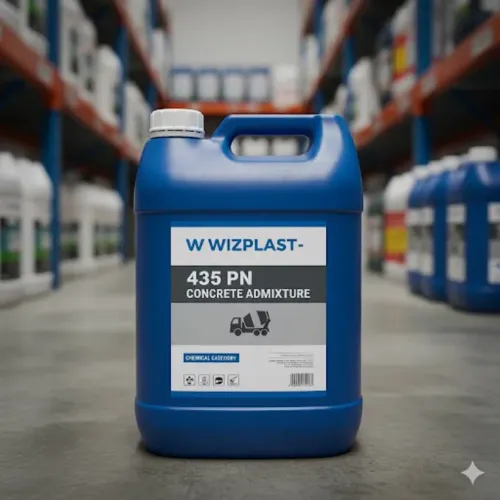
 | PCE Based Admixture WIZPLAST-435 PN is a high-performance PCE (Polycarboxylate Ether) based concrete admixture designed to enhance the workability and durability of... View product → |